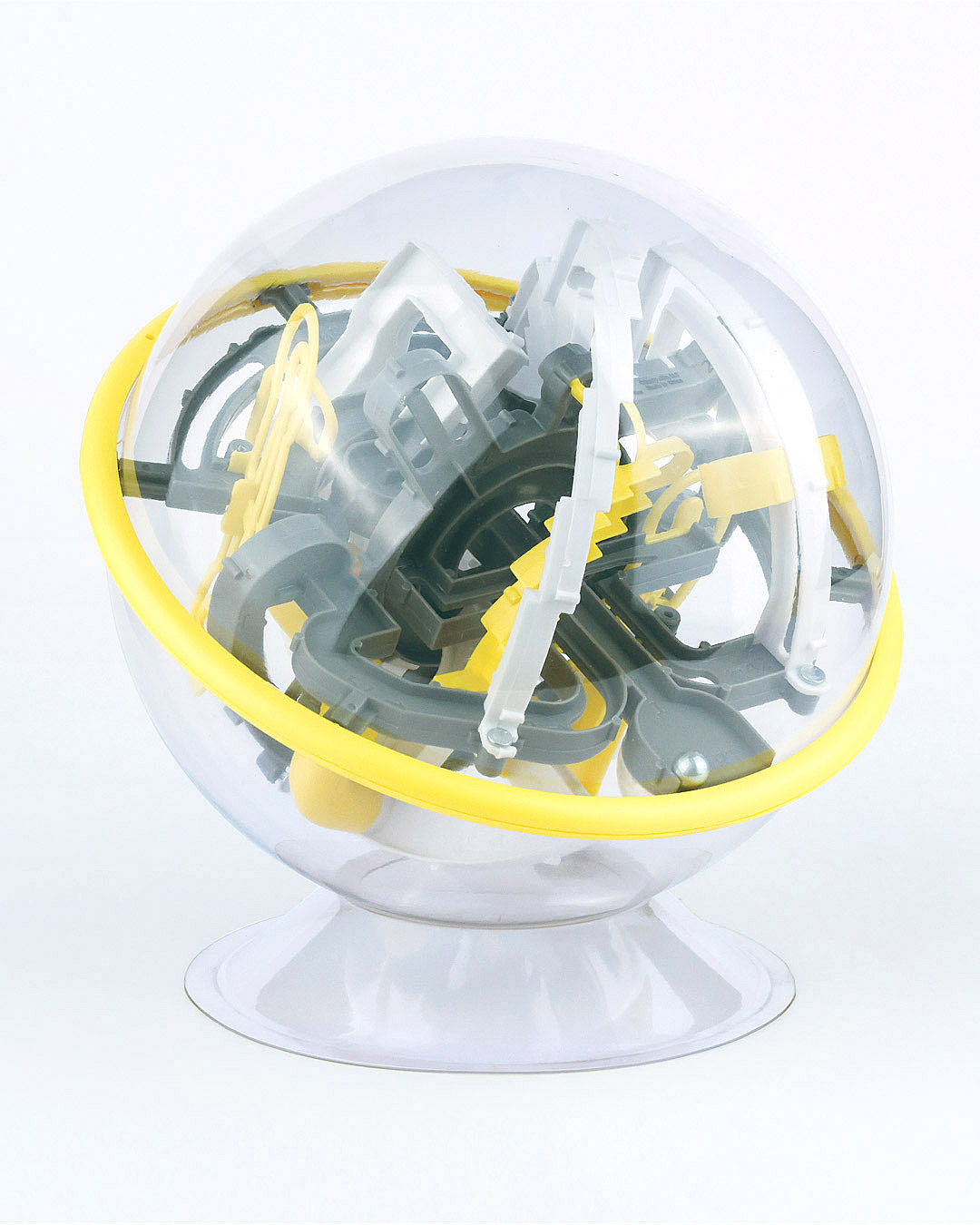
The Kid with a Maze in His Head
Mike McGinnis was a quiet kid who could always be found scrawling intricate mazes.
In 1979, as a high school student in California, he was given an art project to design a board game. He built a 3D maze instead. Encased in a plastic cube, a ball bearing had to be guided along a balsa wood track’s twists and turns from start to finish. It was a hit with his teacher and classmates.
While the art project was over, he persisted with the idea. In college, his teacher encouraged him to contact toy manufacturers. Glowing with praise, he phoned Hasbro.
“If it’s a cube, you’re doomed from the start,” they said, referring to the market dominance of another cube-shaped puzzle, designed by Ernő Rubik.
McGinnis moved on, and 17 years passed. Now working as an art teacher, he found he still couldn’t get the 3D maze out of his head.
By chance one day in class, he asked a student if they knew anyone in the toy industry.
“My brother!” Erin Montague replied.
This was how he met John Montague, who told him over the phone not to get his hopes up.
“Every man and his dog has a toy idea”, he said.
Thanks to his sister’s introduction, however, Montague agreed to meet in San Francisco to take a look at a prototype, where his initial disinterest did an about turn.
“I’ve never seen anything like it!” he exclaimed.
Montague set up a meeting for McGinnis with KID Group, a group of well-respected inventors. They began working together on prototypes, switching the cube casing to a sphere, and the game’s name from the somewhat sinister ‘Psychopath’, to ‘Perplexus’.
McGinnis was finally making progress, but he was also exhausted and his eyes were strained to the point of aching.
He’d had been working around the clock by lamp light in a dilapidated house, producing prototypes for KID at a moment’s notice, who were shopping them to buyers.
“No wonder your eyes hurt, you have no depth perception.” McGinnis was told by an eye doctor following tests.
Incredibly, his test results showed he lacked the ability to judge the distance of objects and their relative position in space. Describing the work he did to the doctor, and that he had a degree in sculpture, she suggested it was possible he’d simply learnt to process three dimensions in his own unique way.
Overcoming these hurdles, in 1999 the Perplexus was launched at the New York International Toy Fair. Hugely popular, it garnered the attention of the world’s biggest toy manufacturers.
After 30 years of development, in 2002, Perplexus was released worldwide – through Hasbro, ironically – becoming a global hit, and one of the world’s greatest toy stories.