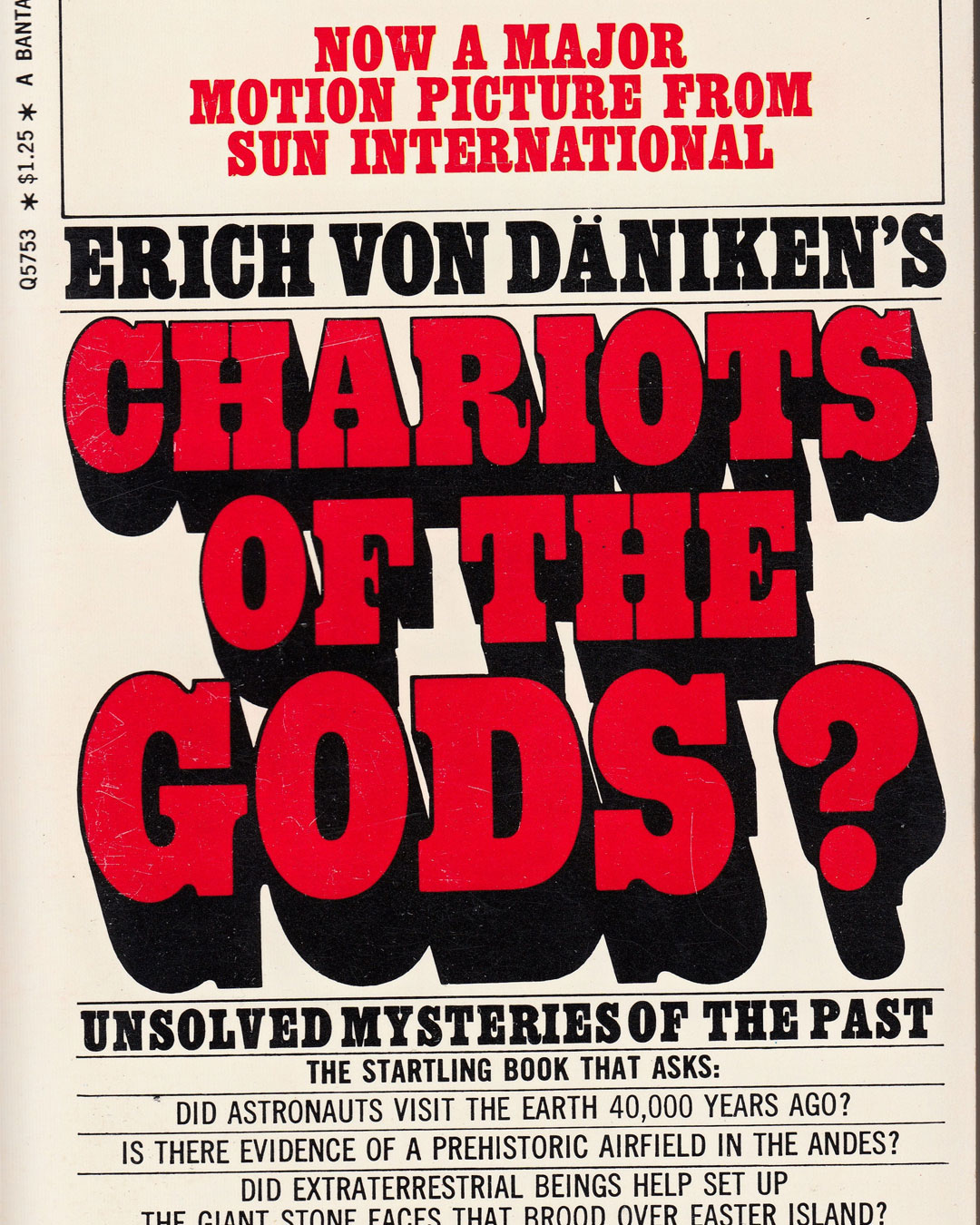
Chariots of the Gods?
Born in Switzerland in 1935, Erich von Däniken was like most boys, possessed by a wild imagination fuelled with mysteries of ancient cultures and the possibility of extraterrestrial life. However, for Däniken these themes burned brighter than most.
In adolescent life, he firmly rejected the church’s interpretation of biblical events. These views pushed him to the fringes of society, and at the age of 19 he was given a four-month suspended sentence for theft.
His obsession led him to Egypt, where he lived for a time in the mid 1960s. There he wrote “Were Our Ancestors Visited from Space?”. To his delight, it was published in the German periodical Der Nordwesten. In his piece he proposed that ancient civilisations were visited by aliens, resulting in remarkable technological jumps in evolution.
His rejection of society’s norms manifested itself again when he became involved in an Egyptian jewelry deal gone wrong. Upon his return to Switzerland, he was imprisoned for nine-months on charges of fraud and embezzlement.
Following his release, he took work as a manager at Hotel Rosenhügel amongst the snow-dusted pines of Davos. Unable to shake his obsession, Däniken worked on a manuscript late at night after the hotel’s guests had retired. He called it “Chariots of the Gods?”.
The manuscript proposed that the only logical explanation for the precision and alignment of the pyramids, Stonehenge, and the Maoi of Easter Island, was alien technology. He cited ancient artifacts, Japanese dōgu among them, as resembling “extra-terrestrial astronauts”, and that Peru’s Nazca Lines were created to attract the return of extraterrestrial visitors.
The initial draft was rejected by every publisher he approached, dismissed as the crazy ramblings of a crackpot conspiracy theorist. To his credit, Däniken persisted, and in 1968 he found a German publisher, Econ Verlag, who was willing to listen. Verlag agreed to publish the book provided it was rewritten by a professional author, to which Däniken agreed.
Against all expectations, the book gained widespread interest and became a bestseller. Critics were quick to dismiss it, calling it speculative at best, and accused Däniken of misinterpreting or fabricating evidence. The media buzz, however, only served to ignite public interest.
Chariots of the Gods went on to strike a chord with readers around the world. People were fascinated by the possibility that humanity’s history was more complex and intriguing than they’d been led to believe.
Today, Däniken’s book has sold over 70 million copies. His ideas continue to spark debates, influencing countless writers, TV shows, and movies. Whether you agree with him or not, there’s no denying that Däniken left a mark on popular culture and our perception of ancient history.