Tiny Fables Art Popup Report
What I learned running a 5 day popup in a Tokyo cafe.
I’ve been working as an artist since 2021, mostly in Tokyo.
While I’ve exhibited my work in Tokyo five times over the past six years, it’s really only in 2026 that I’ve started taking a serious approach to selling my work.
Up until mid-2025 I had full time design work. Sharing my art brought me joy (it still does!) and it didn’t need to be profitable.
In August 2025 though, a big design contract I’d held for 15 years ended, and now it’s never been more important to support myself and my family with my art.
So what does getting serious about art sales look like?
First, building up a base of supporters. I’m an Australian based in Japan, so my approach is to focus on collectors in Japan and Australia. That means posting content on Instagram and my e-commerce site in both countries, but with a lean towards finding Japanese collectors.
I’m also putting a lot of effort into building my mailing lists – one for English speakers and the other for Japanese. Whenever I announce a new collection or show an email goes out to them, often with an exclusive, like free shipping (join here).
To build my mailing lists, I offer a free pack of my trading cards for people who sign up at events, such as talks I give or shows I put on, and it’s been very effective. Two of the artworks I sold at the latest popup were a direct result of the mailing list.
Tefu Lounge, Shimokitazawa
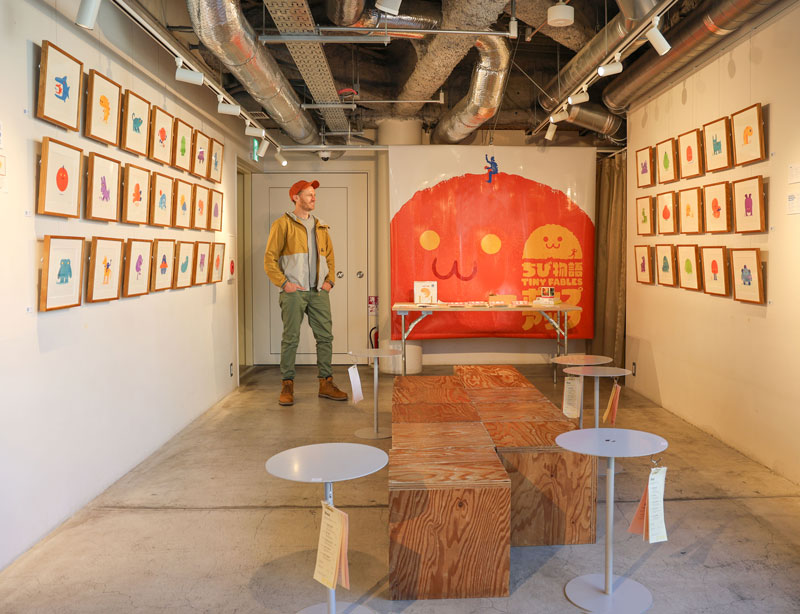
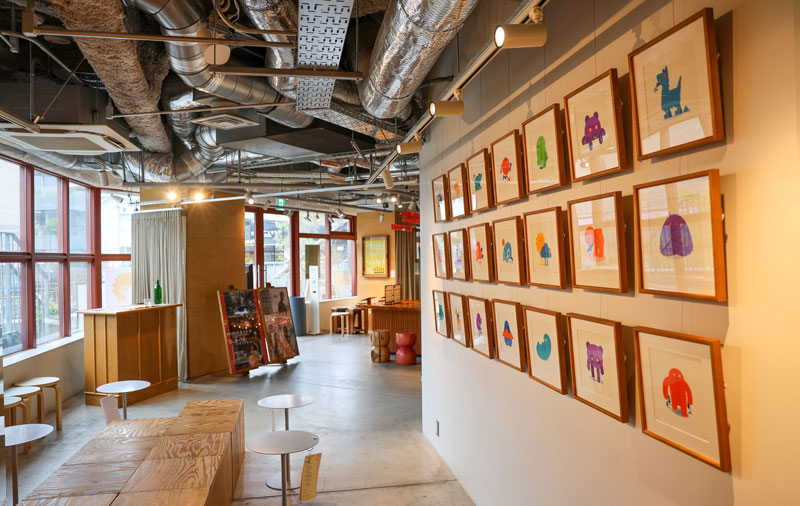
I’ve just finished a 5 day show at Tefu Lounge, Shimokitazawa. It ran from Wednesday 1 April until Sunday 5 April, 9am to 8pm. The cafe also features desk space for rent and a small cinema, so many of the customers were regular workers and movie goers as well.
I figured I would be counting on spontaneous purchases, as most people would come into the popup space on their way to the cafe, work, or cinema. At a later date it will be interesting to compare this event with the Design Festa booth in May, where the visitors are intentionally shopping for art.
It was interesting spending 9 to 10 hours a day in the cafe space and seeing the ebb and flow of people. It was generally quite unpredictable, though the busiest times tended to be after lunch and into the early evening.
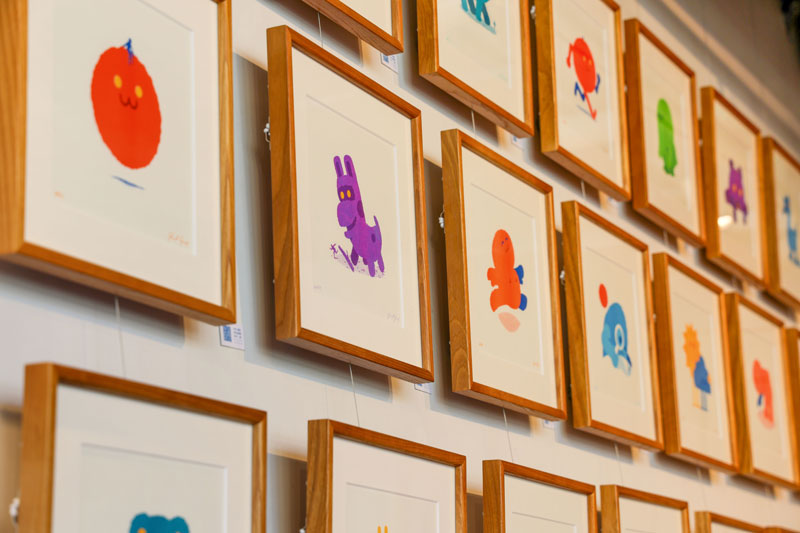
The response to the artwork was great. The work is vibrant, humourous and charming, and was constantly drawing people into the space.
Sales
Over 5 days I‘d estimate between 500 people came into the popup space with intention to view the work. Many more used the cafe seating within the popup space.
As to be expected, the goods — a book (¥1,500) and sticker sheets (¥600) – sold more than the higher priced artwork (¥22,000). In total I sold 16 books, 20 sticker sheets, and 4 artworks.
I made an effort to talk to visitors as often as I could, and this often resulted in people taking something home with them.
For the framed artworks, two different buyers each purchased two artworks. One buyer was a past collector who learned of the show from the mailing list. The other was an artist/friend visiting from Australia who purchased the work for their daughters’ bedrooms.
Total sales came to ¥124,000. Event costs (space rental, advertising) came to ¥162,600. Product costs for the collection (art production, framing) came to ¥494,707.
I won’t factor in product costs until all the shows for this collection are complete. However, just subtracting the event costs from the sales at this event unfortunately resulted in a loss of ¥38,600.
On a positive note, let’s consider the longer term, intangible benefits.
Intangible benefits
Good outcomes that don’t have an immediate monetary benefit are harder to measure. Here are some ways I think I will benefit in future from this popup:
Into the funnel
In marketing, the ‘sales funnel’ is the journey from people becoming aware of what you’re selling (top of the funnel) to actually buying it (bottom of the funnel). That zone between awareness and purchase is called the ‘consideration phase’. Holding public events like this popup exposes my work to a lot of people, and by doing so brings people closer to an eventual purchase.
Credibility boost
When I propose collaborations with brands, which is something I’m currently working on, showing I’ve exhibited the work boosts credibility. It’s also good for my artist’s CV and artist’s journey in general.
Networking and opportunities
Another intangible benefit is networking. Exchanging business cards, Instagram profiles, talking with business owners about possible commissions, and talking with artists at different stages of their journey and gaining insights. I’ve sent off some emails after the show, following up leads.
Costs of putting on the event
Instagram boosts
I spent ¥36,600 boosting two IG Reels in the week leading up to the event, which resulted in 30,000 views, 1,100 profile visits, and 200 new followers. A number of people who visited the show said they came expressly because of seeing the Reels. Repeated exposure over time to these customers increases the chance of them collecting.
Mailling list
Sending out an email to the Japan mailing list, with 30 subsscriers before the show, cost ¥830. I added 21 new subscribers during the show by offering a free item.
Insights
People that came through the gallery space were overwhelmingly positive about the artwork, especially when I spoke to them and explained the idea behind the work and the Riso printing process. The work has broad appeal, it isn’t what I’d consider to be niche or divisive.
Talking to visitors often helped customers decide to purchase. In one case, someone I’d talked to for 20 minutes was going to leave, then purchased a few items when they saw someone else approaching the register — they were happy to buy, the idea just hadn’t occurred to them.
I got the sense that buyers were confident when it came to purchasing the lower priced goods, but while there was plenty of people looking at the artworks, there was little obvious signs of consideration for purchasing. Admittedly the price labels were very subtle, making them more prominent couldn’t have hurt.
One question I’d love an answer to is – do Japanese consumers need convincing about the benefits of displaying art in their homes? Is it a foreign idea, culturally? I’ve heard many anecdotes about this, but seen no conclusive evidence.
Another – is selling artwork in a non-gallery space a bad idea? Psychologically, is it a barrier for people coming to buy coffee to switch into art buying mode? And finally, in a country with a low minimum wage, are people with enough disposable income to spontaneously purchase a ¥22,000 artwork harder to find? These are questions I crave an answer for.
What I do know – Oozu-san’s Tokyo Pixel is a model showing that it can work. I see the shows held there sell out time and again, through a combination of physical and digital sales. I believe this is achieved through the strong following that the gallery and the artists who exhibit there have, often in the tens of thousands; and by generating fear-of-missing-out – the artworks/goods are released only when the show opens and there’s an expectation that they will sell out quickly.
Connecting with other people interested in art is amazing. There’s no better way to do this than in person, but we can’t be everywhere at once, and that’s where social media/SNS comes in.
Nanako-san at KEKE Tufting Studio told me that Threads was really effective for them at reaching new customers. I also see Oozu-san of Tokyo Pixel posting there regularly. I will start posting on Threads in the lead up to the Design Festa show in May.
My current attitude to Instagram is that it’s an amazing way to swap details quickly when meeting with other artists. As far as discovery or staying in touch with other artists’ feeds goes though, if you’re not posting daily, you pretty much become invisible. Its saving grace is that boosting Reels in the lead up to an event is a very effective way of getting people to the show and attracting more followers.
What’s next
I’ll have a booth at Design Festa, Tokyo Big Sight, on Saturday 23 and Sunday 24 May, 2026. I’ll be in the West Wing in section F, booth 83.
If you’ve got some advice or thoughts, please share! The best way to get in touch is to leave me a DM on Instagram.
Craig, AKA Ghoul Guy